
Friction Springs
Maintenance-free safety components for the precise absorption of sudden forces and the controlled dissipation of high kinetic energies – compact, robust and individually configurable for demanding applications in machinery, vehicles, buildings and safety-critical infrastructure
- Ideally suited for demanding damping, compensation and overload protection functions across a wide range of technological sectors
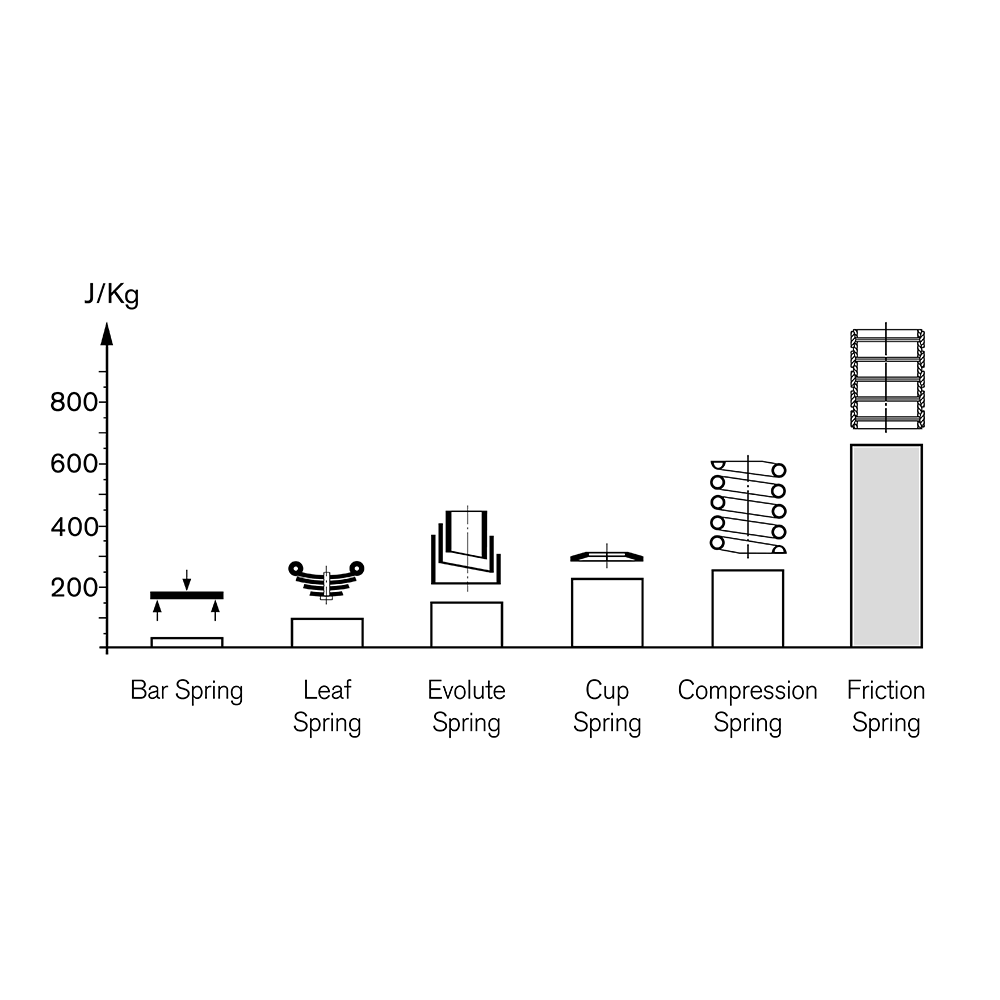
- High spring work at low weight and volume through optimum utilization of the spring material – perfectly suited for high-performance damping solutions wherever enormous forces must be controlled within restricted installation space
- High damping performance with a standard energy absorption rate of 66 %, enabling rapid dissipation of introduced energy, effective reduction of recoil forces and efficient suppression of resonance effects
- Full spring work and damping effect independent of loading speed – even under slow movements, large masses or low impact velocities, maximum damping capacity remains fully available
- Overload-safe in block position, maintenance-free in operation and temperature-independent within the specified operating range for maximum operational safety, extended service life and dependable protection of the overall structure
- Available as proven standard designs or custom-engineered special solutions – featuring parallel and serial arrangements for increased force capacity or extended spring travel, as well as an application-specific, adjustable damping effect
Product Characteristics
Your Benefits
RINGFEDER® Friction Springs are maintenance-free safety components designed for demanding damping, compensation and overload protection functions. They are used wherever sudden forces must be absorbed, high kinetic energies controlled or enormous forces managed safely within limited installation space.
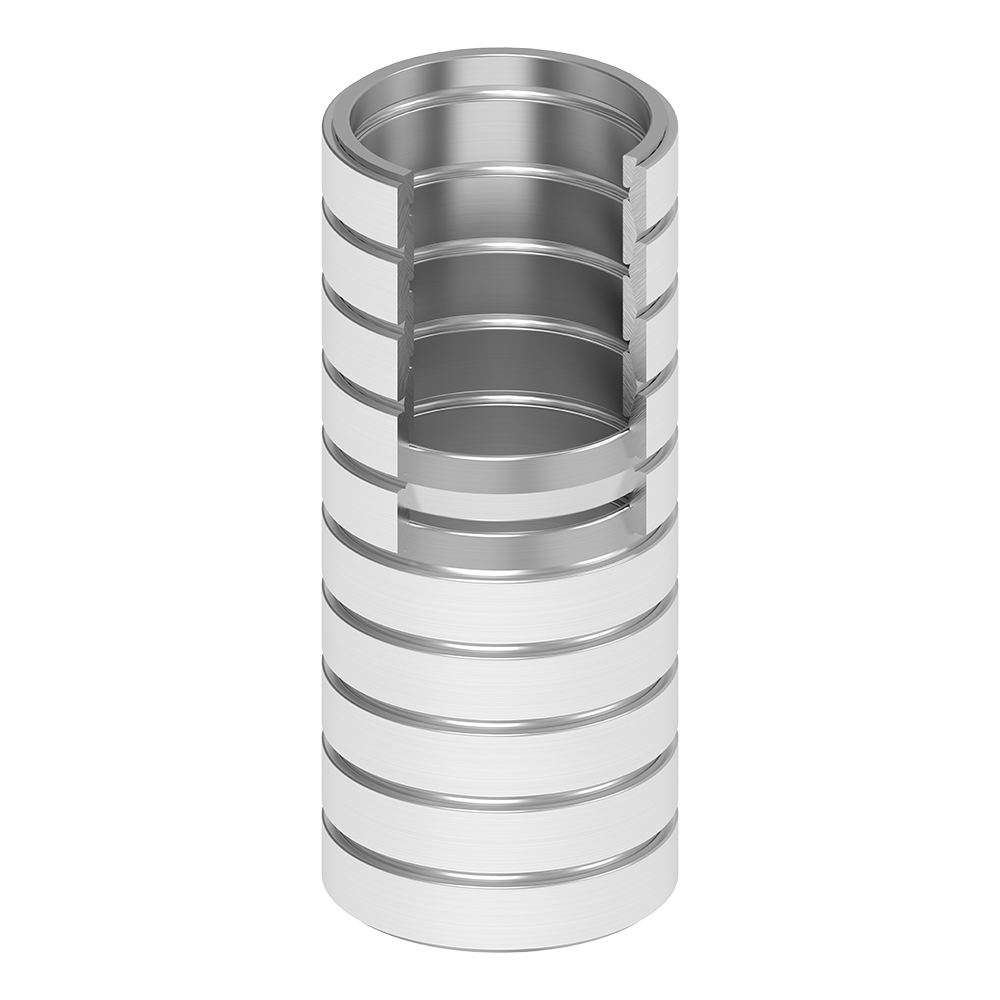
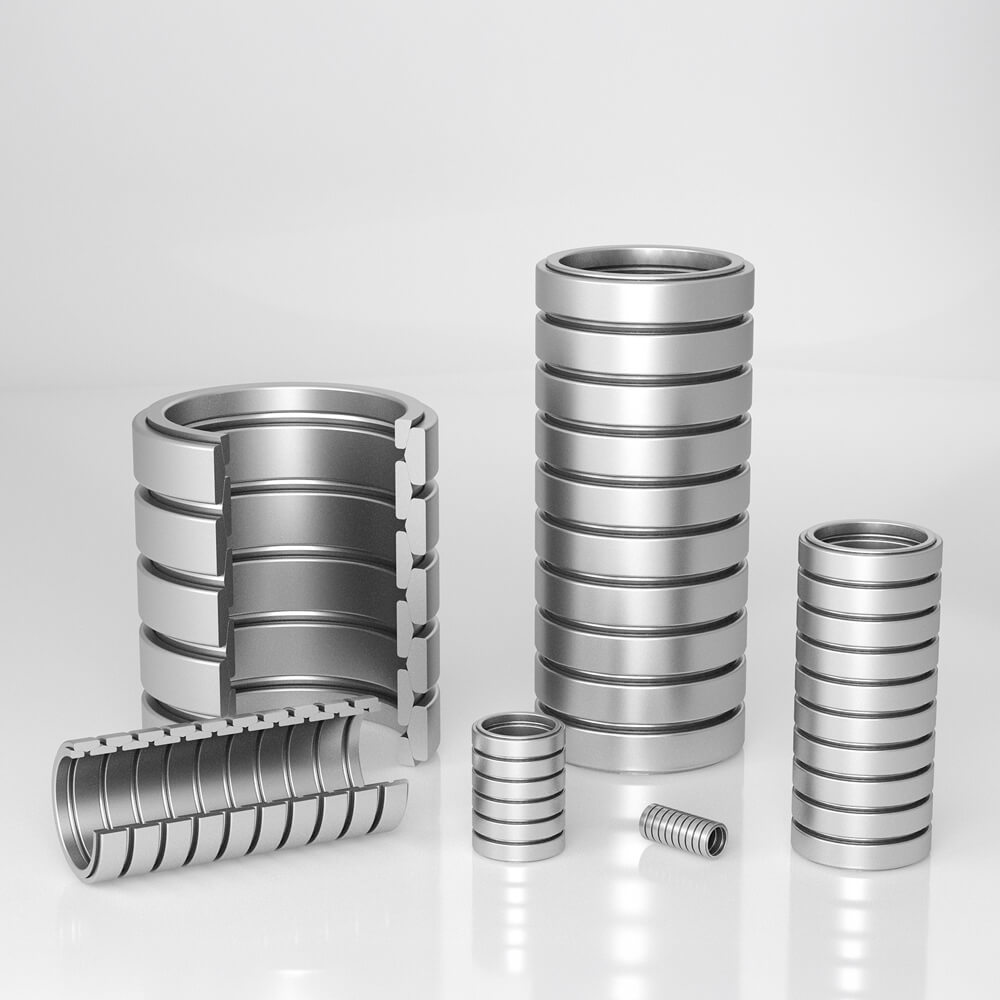
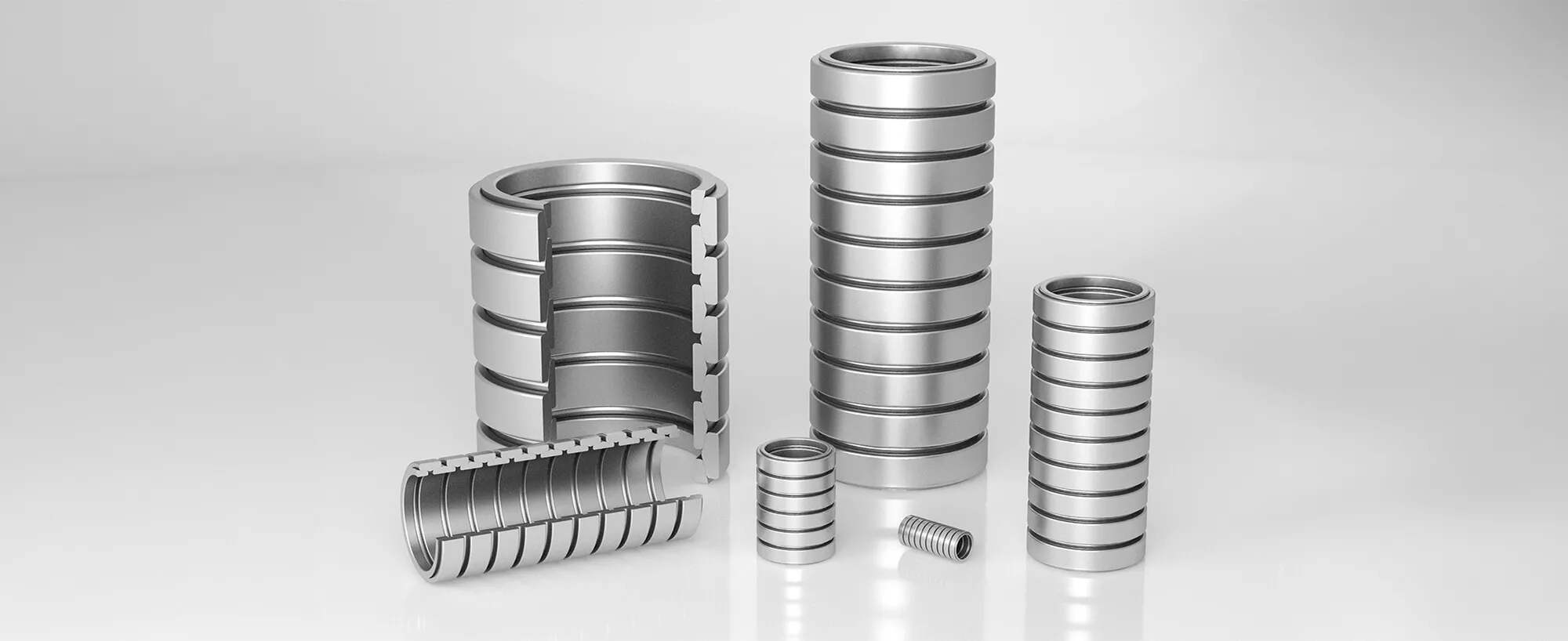
They consist of precisely manufactured inner and outer rings assembled into complete spring columns according to the specific application requirements. Before delivery, each spring column undergoes multiple inspections and load tests to ensure high operational safety throughout its service life.
Compared to conventional spring and damping solutions, RINGFEDER® Friction Springs offer high spring work with low weight and compact dimensions, high damping effect, reliable performance independent of loading speed and are overload-safe in block position. In addition, they are maintenance-free in operation and can be configured either as proven standard designs or custom-engineered special solutions.
Proven Principle, Superior Operating Characteristics
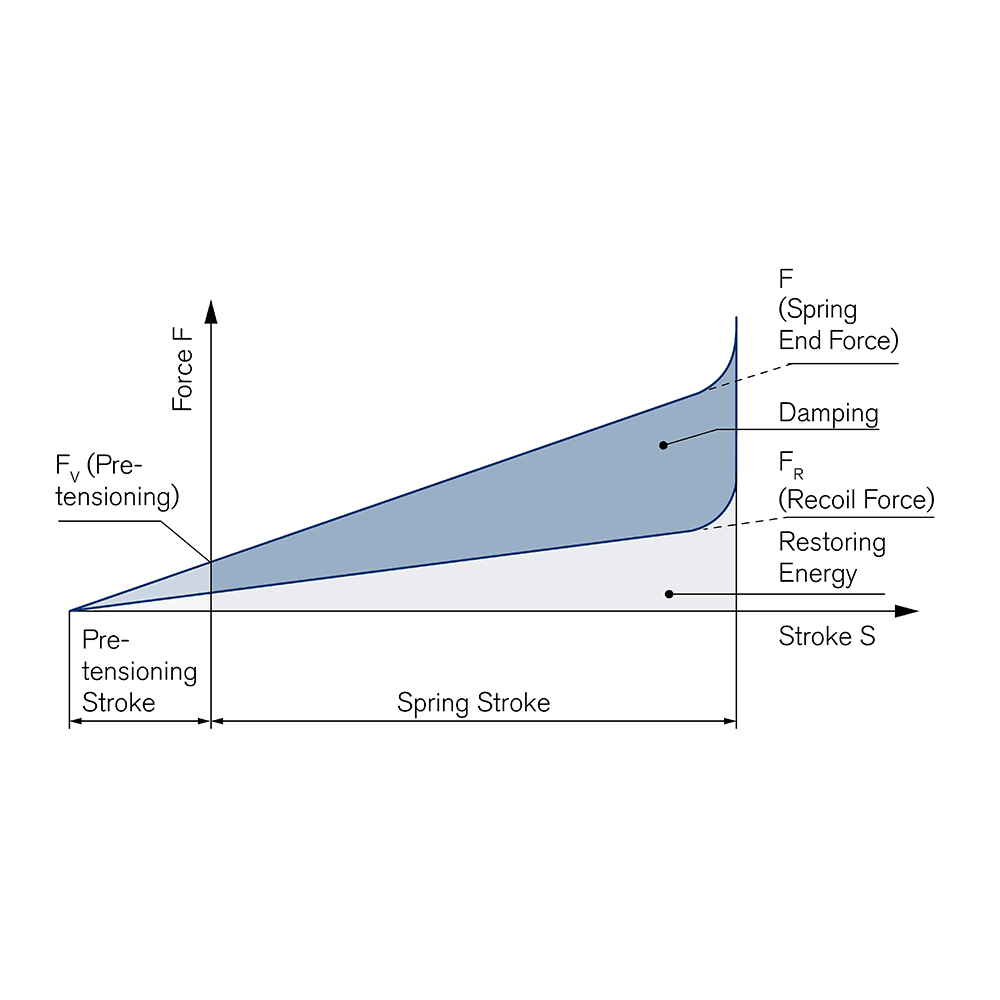
RINGFEDER® Friction Springs mechanically absorb introduced energy and convert a significant portion of it into heat through controlled friction. Under load, the precisely matched inner and outer rings slide against each other along conical contact surfaces. This generates high friction forces that absorb the introduced impact and kinetic energies and provide effective damping.
Unlike many conventional spring and damping systems, the introduced energy is not merely stored and subsequently released. Instead, RINGFEDER® Friction Springs absorb a substantial portion of the energy directly within the spring column itself. In standard designs with the appropriate lubrication, approximately two-thirds of the introduced energy is converted into frictional heat. The remaining restoring energy, and therefore the resulting recoil force, is significantly reduced.
This operating principle ensures rapid dissipation of impact loads, reduced rebound motion and effective suppression of resonance effects. As a result, RINGFEDER® Friction Springs reliably protect machinery, equipment, vehicles, buildings and safety-critical structures against dynamic loads, damage and excessive vibration.
A key technical advantage is that spring work and damping effect remain independent of loading speed. Unlike many other damping systems, RINGFEDER® Friction Springs deliver their full damping performance even under slow movements, large masses or low impact velocities.
Three key functions of RINGFEDER® Friction Springs in operation:
-
Absorb: Sudden forces and high kinetic energies are introduced into the spring column in a controlled manner and safely absorbed.
-
Damp: A substantial portion of the introduced energy is absorbed through friction and converted into heat, significantly reducing recoil forces and vibration.
-
Protect: Peak loads, resonance effects and dynamic damage are minimized, increasing the service life and operational safety of the overall structure.
High Performance within Compact Installation Space
By making exceptionally efficient use of the spring material, RINGFEDER® Friction Springs achieve high spring work with comparatively low weight and volume. The decisive parameter is not merely the spring force itself, but the amount of spring work that can be absorbed safely within a specific application. As a result, Friction Springs are particularly suitable for applications where high forces must be controlled within restricted installation space.
Overload-Safe, Maintenance-Free and Temperature-Independent
RINGFEDER® Friction Springs are designed as block springs. This ensures that permissible stress limits cannot be exceeded in block position and that the spring remains undamaged even under severe loading conditions. This inherent overload protection contributes significantly to the operational safety and long service life of the entire application.
During operation, RINGFEDER® Friction Springs are generally maintenance-free. Relubrication is normally not required. Only the recommended special lubricants may be used, as the conical contact surfaces are subjected to extremely high contact pressures.
Unlike hydraulic dampers or synthetic springs, the force-stroke diagram of RINGFEDER® Friction Springs is not affected by temperature fluctuations or self-heating. The characteristic curve remains constant throughout the temperature range from -20 °C to +60 °C. Application-specific adaptations are available for operating conditions outside this range.
Specifically Designable for the Individual Application
In addition to proven standard designs, RINGFEDER® Friction Springs can be engineered individually to meet specific customer and application requirements. Through the targeted combination of individual spring elements, spring columns can be adapted to the required spring travel, required spring work and available installation space.
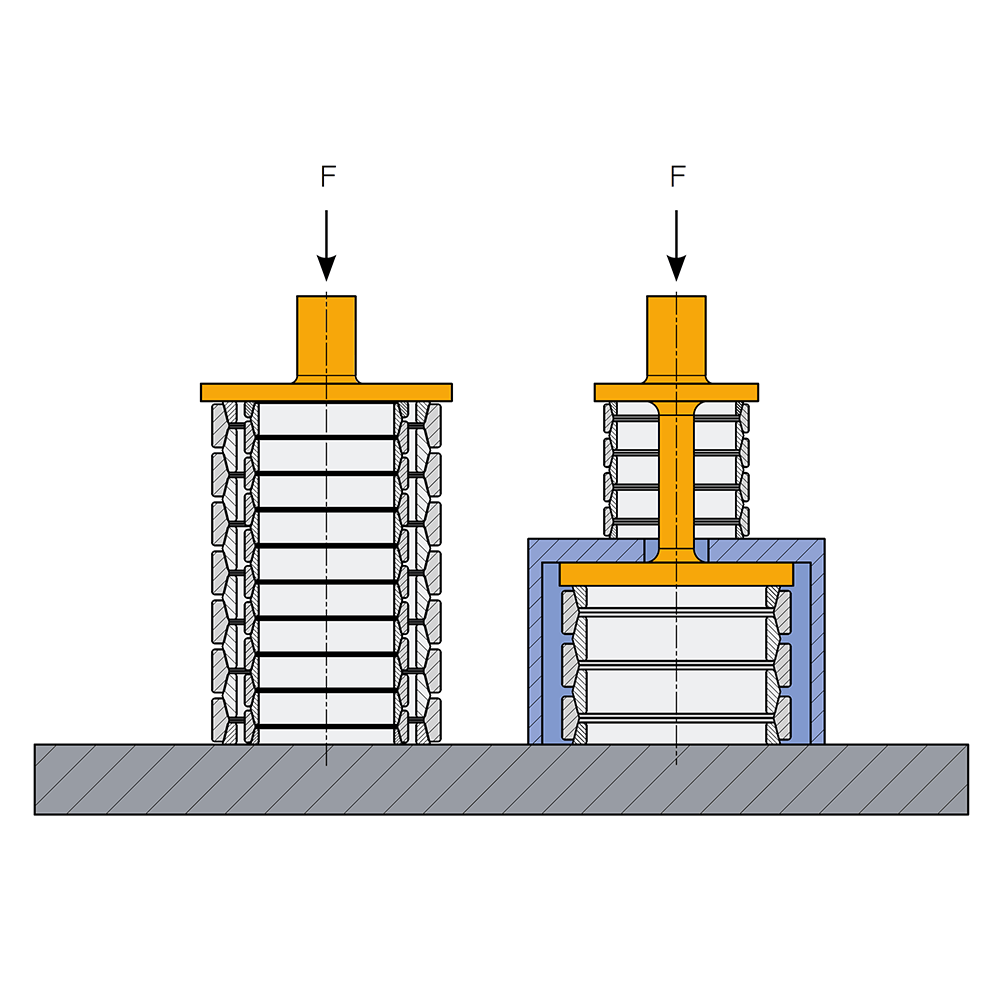
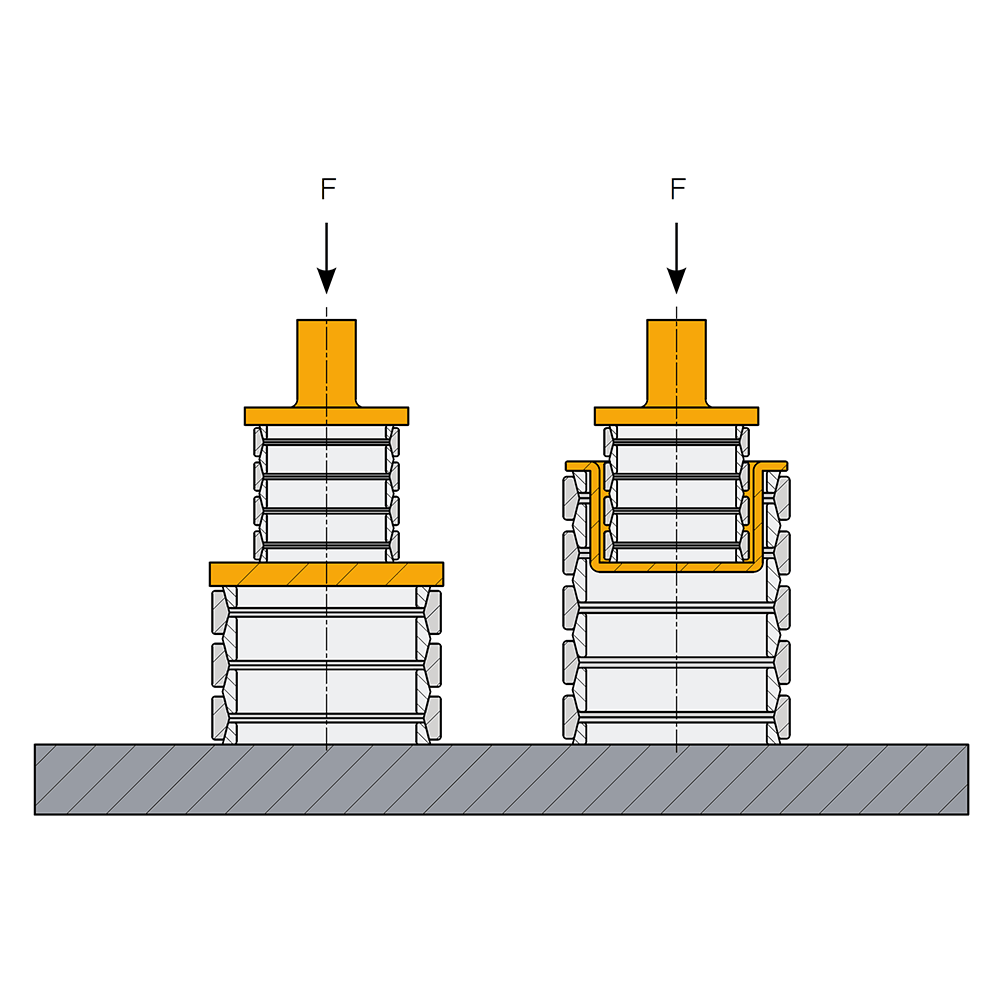
Furthermore, RINGFEDER® Friction Springs can be used in either parallel or serial arrangement. A parallel arrangement provides increased force capacity, while a serial arrangement enables greater spring travel. This allows available installation space to be utilized optimally while tailoring the damping solution precisely to the application.
The damping effect itself can also be adapted to specific requirements. While standard designs provide approximately 66 % damping, reduced damping values down to approximately 33 % can be achieved through the use of suitable lubricants.
Main Areas of Application
RINGFEDER® Friction Springs are used across numerous industrial sectors where high forces, large masses, severe vibration or safety-critical kinetic energies must be controlled reliably. Typical areas of use include:
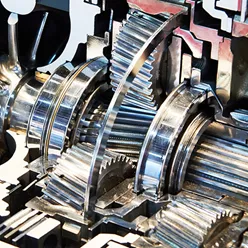
- Mechanical and Plant Engineering
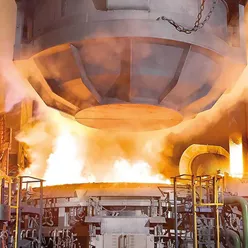
- Heavy Industry and Steel Mills
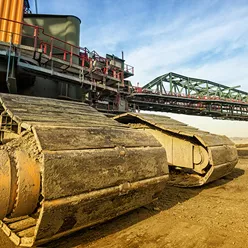
- Conveying Technology and Raw Material Extraction
- Aviation & Aerospace
- Vehicles and Mobile Systems
- Buildings, Structures and Critical Infrastructure
- Customer- and Application-Specific Special Designs
Structure of Friction Springs
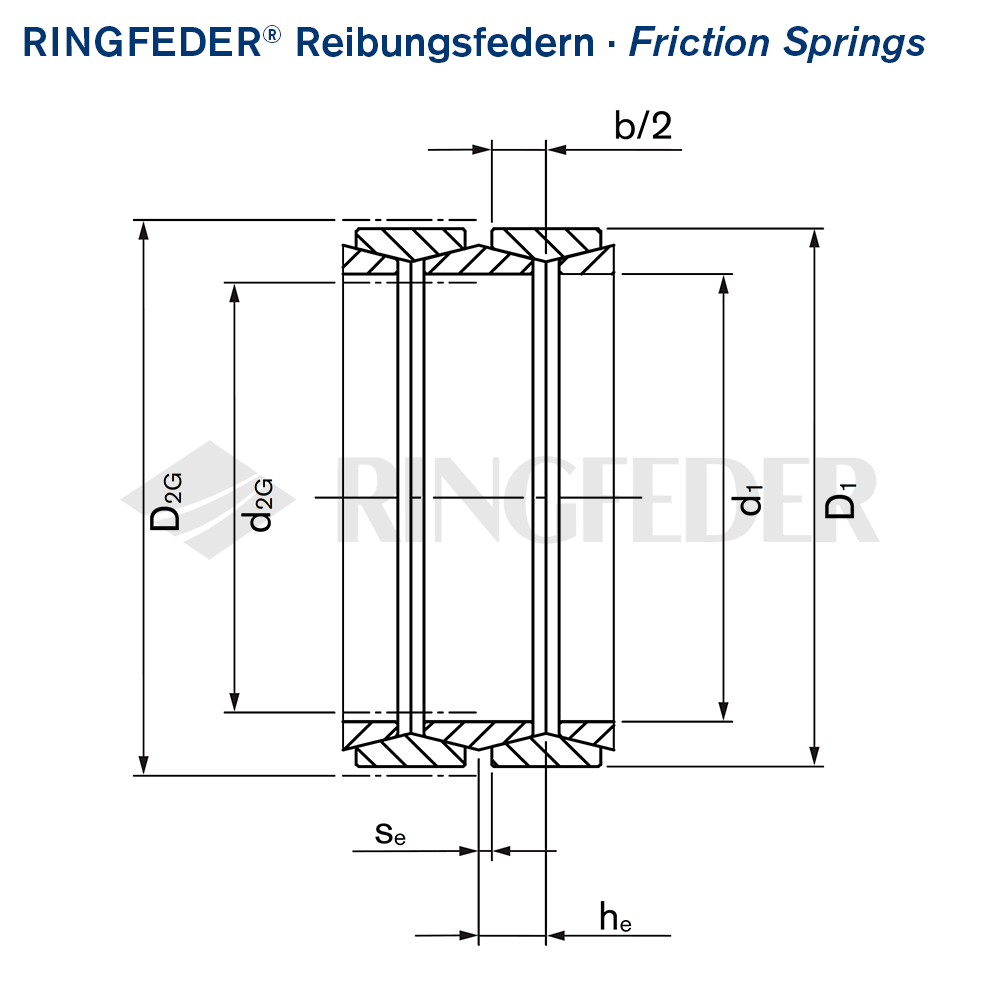
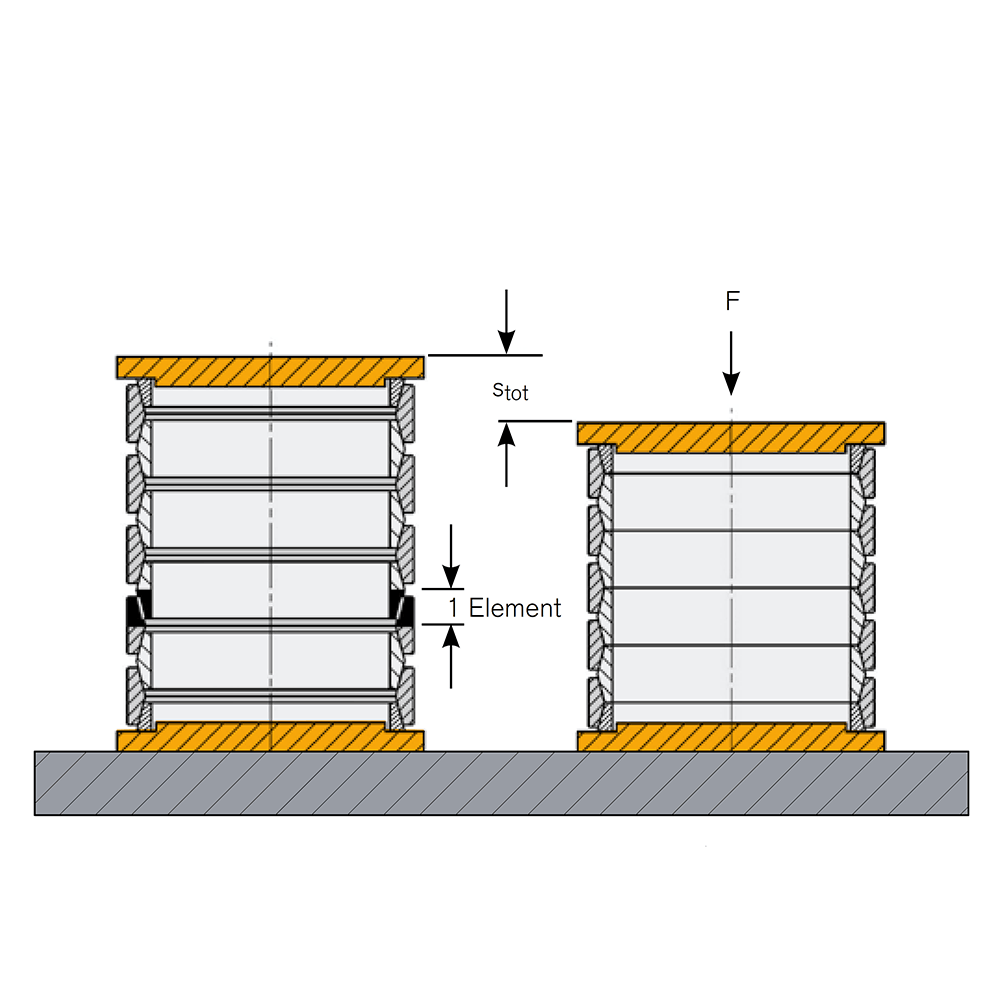
RINGFEDER® Friction Springs consist of multiple precision-manufactured inner and outer rings assembled into complete spring columns. As a rule, a Friction Spring comprising e elements is terminated with half rings.
The unstressed length, total spring travel and spring work are determined by the number of elements used. The end force remains independent of the number of elements. This enables the spring to be calculated accurately and engineered specifically for each application. Accordingly, the following basic relationships apply:
- Unstressed Length: L₀ = e · hₑ
- Total Spring Travel: s = e · sₑ
- Spring Work (excluding pretensioning force): W = e · Wₑ
The corresponding values can be found in the technical data of the respective spring type within the table Technical Data & CAD Models below.
Technical Selection & Installation Notes
To ensure reliable operation and maximum service life, RINGFEDER® Friction Springs must be installed with the correct pretensioning, guidance, lubrication and protection against external influences. Pretensioning should be at least 5 %, preferably 10 % of the spring travel. To avoid impairing the lubricant film, pretensioning force should generally not exceed 50 %.
Depending on the installation arrangement, guidance must be provided either on the inner diameter or the outer diameter. In addition, the spring should be protected from dirt and moisture to preserve the lubricant film permanently. In environments with severe contamination or moisture exposure, suitable protective measures such as bellows are recommended.
For damping applications, the decisive factor is the absorbable spring work, i.e. the area under the loading curve in the force-stroke diagram. Where the spring is required to provide a defined contact force, the lower recoil curve must be considered instead. For optimum system design, specific operating conditions and application requirements should be coordinated with the experts at RINGFEDER POWER TRANSMISSION at an early stage. Furthermore, the detailed selection and operating criteria provided in the PDF document Product Paper RINGFEDER® Damping Technology should be observed.
RINGFEDER® Friction Springs – Functionality of a Friction Spring
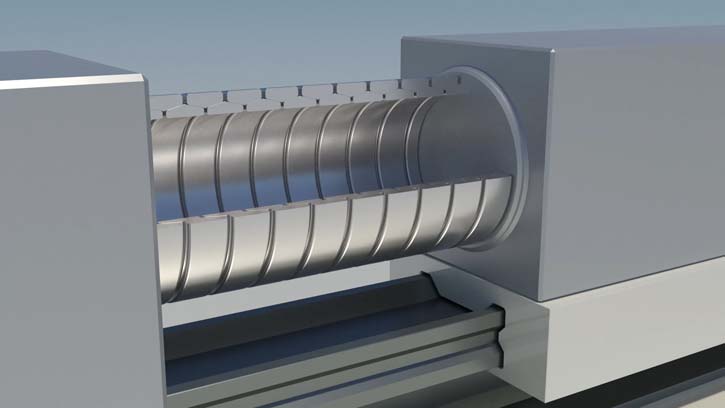
Learn more about application and functionality of our premium-quality, high-performance RINGFEDER® Friction Springs in our short video.
Industrial Dampers with RINGFEDER® Friction Springs
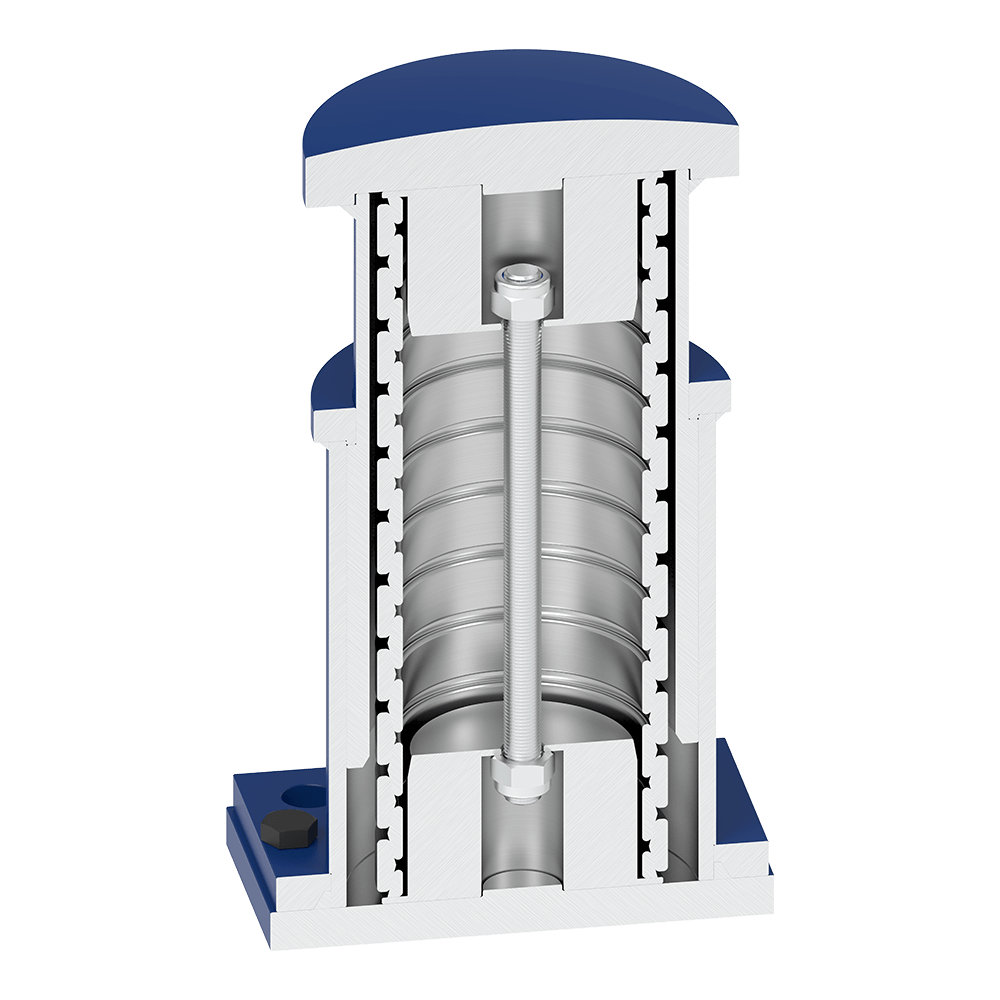
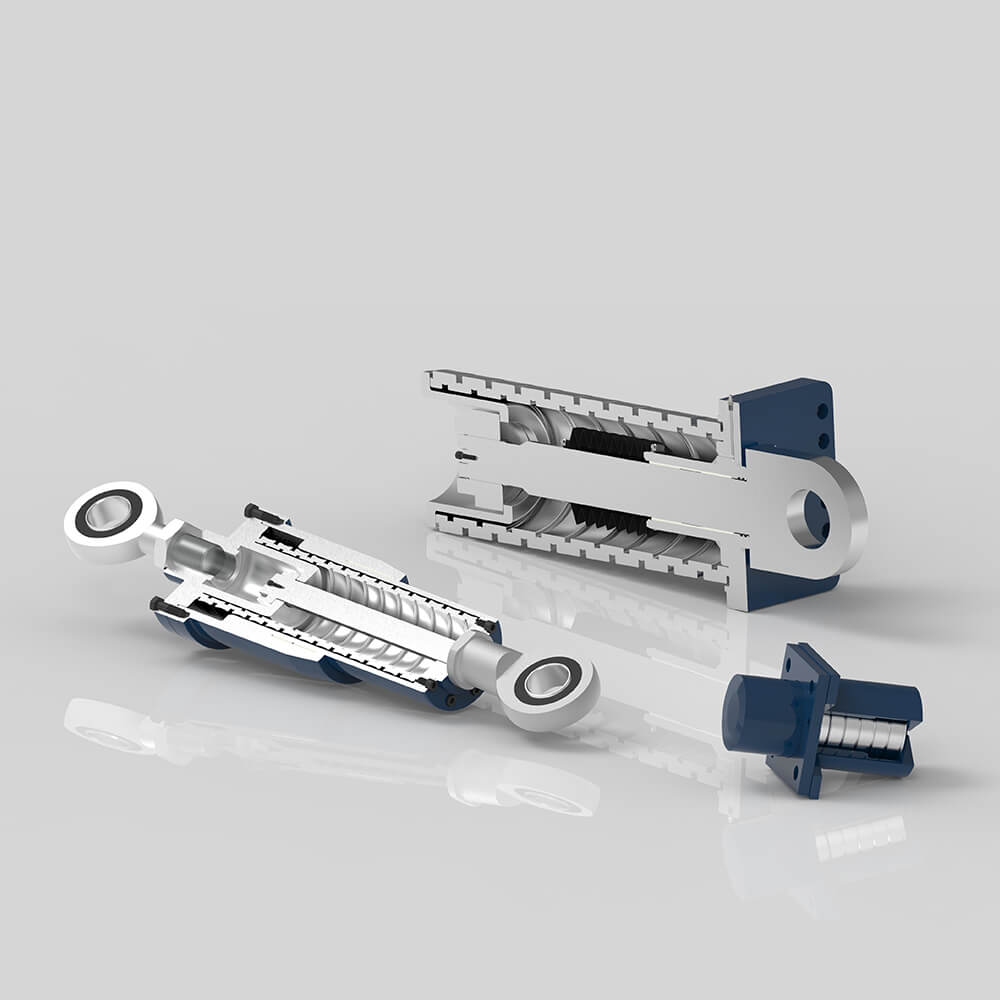
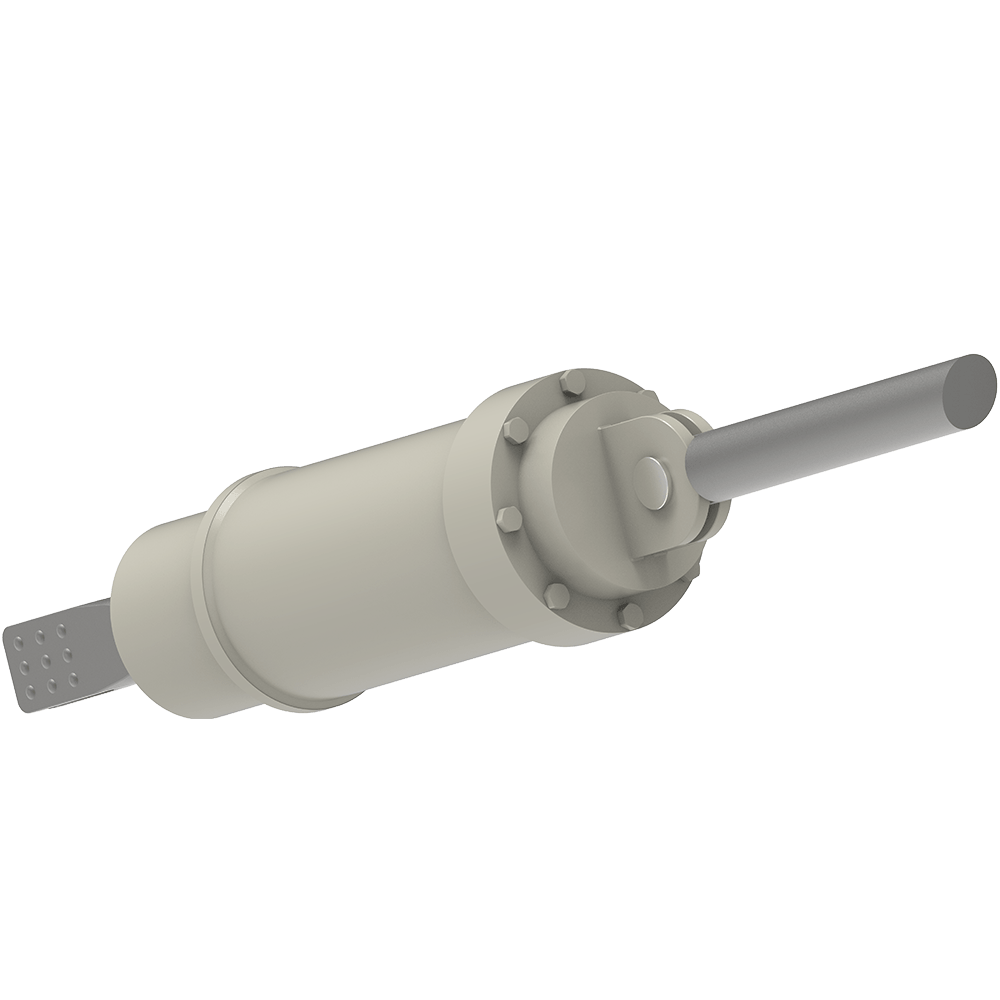
In addition to individual spring columns, RINGFEDER® Friction Springs are also available as complete damper versions engineered in various shapes and sizes to meet specific customer and application requirements. Common configurations include push-pull units used as high-performance vibration dampers or absorbers, as well as slipping clutches providing effective overload protection. With their high energy absorption capacity, compact design and maintenance-free operation, RINGFEDER® Industrial Dampers are ideally suited for demanding applications in mechanical and plant engineering, the aviation and aerospace industry, raw material extraction, energy technology and conveying systems. Further information on RINGFEDER® Industrial Dampers is available on the corresponding Product Detail Page.
Technical Data & CAD Models
You require CAD data for this product? Of course, we are more than happy to provide you with these. Contact us quickly and easily via our request form, by e-mail or using the "Need Help?" feature at the bottom right of this site.
| CAD |
Typ
|
TypF
|
F
kN |
se
mm |
We
Joule |
he
mm |
D1
mm |
d1
mm |
b/2
mm |
D2G
mm |
d2G
mm |
Gwe
kg |
|---|---|---|---|---|---|---|---|---|---|---|---|---|
| 01800 | 1201 | 5 | 0,4 | 1,0 | 2,2 | 18,1 | 14,4 | 1,8 | 18,7 | 13,9 | 0,002 | |
| 02500 | 1202 | 9 | 0,6 | 2,7 | 3,1 | 25,0 | 20,8 | 2,5 | 25,9 | 20,1 | 0,004 | |
| 03200 | 1203 | 14 | 0,8 | 5,6 | 4,0 | 32,0 | 27,0 | 3,2 | 33,1 | 26,1 | 0,007 | |
| 03800 | 1204 | 20 | 0,9 | 9,0 | 4,7 | 38,0 | 31,7 | 3,8 | 39,3 | 30,6 | 0,012 | |
| 04200 | 1205 | 26 | 1,0 | 13,0 | 5,2 | 42,2 | 34,6 | 4,2 | 43,6 | 33,4 | 0,018 | |
| 04800 | 1206 | 34 | 1,1 | 18,7 | 5,9 | 48,2 | 39,4 | 4,8 | 49,8 | 38,1 | 0,026 | |
| 05500 | 1207 | 40 | 1,3 | 26,0 | 6,8 | 55,0 | 46,0 | 5,5 | 56,7 | 44,5 | 0,035 | |
| 06300 | 1208 | 54 | 1,4 | 37,8 | 7,7 | 63,0 | 51,9 | 6,3 | 64,9 | 50,3 | 0,056 | |
| 07000 | 1209 | 65 | 1,6 | 52,0 | 8,6 | 70,0 | 58,2 | 7,0 | 72,1 | 56,4 | 0,074 | |
| 08000 | 1310 | 83 | 1,8 | 75,0 | 9,8 | 80,0 | 67,0 | 8,0 | 83,0 | 64,0 | 0,105 | |
| 09000 | 1311 | 100 | 2,0 | 100,0 | 11,0 | 90,0 | 75,5 | 9,0 | 93,0 | 73,0 | 0,145 | |
| 10000 | 1312 | 125 | 2,2 | 138,0 | 12,2 | 100,0 | 84,0 | 10,0 | 103,0 | 81,0 | 0,203 | |
| 12400 | 1314 | 200 | 2,6 | 260,0 | 15,0 | 124,0 | 102,0 | 12,4 | 128,0 | 98,0 | 0,408 | |
| 13000 | 1313 | 160 | 2,6 | 208,0 | 15,0 | 130,0 | 111,5 | 12,4 | 134,0 | 108,0 | 0,376 | |
| 14000 | 1315 | 250 | 3,0 | 375,0 | 17,0 | 140,0 | 116,0 | 14,0 | 144,0 | 112,0 | 0,568 | |
| 16600 | 1316 | 350 | 3,7 | 648,0 | 20,0 | 166,0 | 134,0 | 16,0 | 170,0 | 130,0 | 0,869 | |
| 19600 | 1318 | 600 | 4,4 | 1320,0 | 23,4 | 194,0 | 155,0 | 19,0 | 199,0 | 150,0 | 1,676 | |
| 20000 | 1317 | 510 | 3,9 | 995,0 | 22,4 | 198,0 | 162,0 | 18,5 | 203,0 | 157,0 | 1,570 | |
| 22000 | 1319 | 720 | 4,4 | 1584,0 | 26,4 | 220,0 | 174,0 | 22,0 | 225,0 | 169,0 | 2,573 | |
| 26200 | 1320 | 860 | 4,8 | 2064,0 | 25,8 | 262,0 | 208,0 | 21,0 | 268,0 | 202,0 | 3,415 | |
| 30000 | 1221 | 1000 | 5,8 | 2900,0 | 35,8 | 300,0 | 250,0 | 30,0 | 306,0 | 245,0 | 5,510 | |
| 32000 | 1222 | 1200 | 6,2 | 3720,0 | 38,2 | 320,0 | 263,0 | 32,0 | 326,0 | 258,0 | 7,060 | |
| 35000 | 1223 | 1400 | 6,6 | 4620,0 | 41,6 | 350,0 | 288,0 | 35,0 | 356,0 | 283,0 | 9,180 | |
| 40000 | 1224 | 1800 | 7,6 | 6840,0 | 47,6 | 400,0 | 330,0 | 40,0 | 407,0 | 324,0 | 13,560 |
| CAD |
Typ |
TypF |
F lbs |
se inch |
We ft-lbs |
he inch |
D1 inch |
d1 inch |
b/2 inch |
D2G inch |
d2G inch |
Gwe lbs |
|---|---|---|---|---|---|---|---|---|---|---|---|---|
| 01800 | 1201 | 1124 | 0.016 | 0.74 | 0.087 | 0.713 | 0.567 | 0.071 | 0.74 | 0.55 | 0.004 | |
| 02500 | 1202 | 2023 | 0.024 | 1.99 | 0.122 | 0.984 | 0.819 | 0.098 | 1.02 | 0.79 | 0.009 | |
| 03200 | 1203 | 3146 | 0.031 | 4.13 | 0.157 | 1.260 | 1.063 | 0.126 | 1.30 | 1.03 | 0.015 | |
| 03800 | 1204 | 4495 | 0.035 | 6.64 | 0.185 | 1.496 | 1.248 | 0.150 | 1.55 | 1.20 | 0.026 | |
| 04200 | 1205 | 5843 | 0.039 | 9.59 | 0.205 | 1.661 | 1.362 | 0.165 | 1.72 | 1.31 | 0.040 | |
| 04800 | 1206 | 7641 | 0.043 | 13.79 | 0.232 | 1.898 | 1.551 | 0.189 | 1.96 | 1.50 | 0.057 | |
| 05500 | 1207 | 8989 | 0.051 | 19.18 | 0.268 | 2.165 | 1.811 | 0.217 | 2.23 | 1.75 | 0.077 | |
| 06300 | 1208 | 12136 | 0.055 | 27.88 | 0.303 | 2.480 | 2.043 | 0.248 | 2.56 | 1.98 | 0.123 | |
| 07000 | 1209 | 14608 | 0.063 | 38.35 | 0.339 | 2.756 | 2.291 | 0.276 | 2.84 | 2.22 | 0.163 | |
| 08000 | 1310 | 18653 | 0.071 | 55.32 | 0.386 | 3.150 | 2.638 | 0.315 | 3.27 | 2.52 | 0.231 | |
| 09000 | 1311 | 22474 | 0.079 | 73.76 | 0.433 | 3.543 | 2.972 | 0.354 | 3.66 | 2.87 | 0.320 | |
| 10000 | 1312 | 28092 | 0.087 | 101.78 | 0.480 | 3.937 | 3.307 | 0.394 | 4.06 | 3.19 | 0.448 | |
| 12400 | 1314 | 44947 | 0.102 | 191.77 | 0.591 | 4.882 | 4.016 | 0.488 | 5.04 | 3.86 | 0.899 | |
| 13000 | 1313 | 35958 | 0.102 | 153.41 | 0.591 | 5.118 | 4.390 | 0.488 | 5.28 | 4.25 | 0.829 | |
| 14000 | 1315 | 56184 | 0.118 | 276.59 | 0.669 | 5.512 | 4.567 | 0.551 | 5.67 | 4.41 | 1.252 | |
| 16600 | 1316 | 78658 | 0.146 | 477.95 | 0.787 | 6.535 | 5.276 | 0.630 | 6.69 | 5.12 | 1.916 | |
| 19600 | 1318 | 134842 | 0.173 | 973.59 | 0.921 | 7.638 | 6.102 | 0.748 | 7.83 | 5.91 | 3.695 | |
| 20000 | 1317 | 114616 | 0.154 | 733.88 | 0.882 | 7.795 | 6.378 | 0.728 | 7.99 | 6.18 | 3.461 | |
| 22000 | 1319 | 161811 | 0.173 | 1168.31 | 1.039 | 8.661 | 6.850 | 0.866 | 8.86 | 6.65 | 5.672 | |
| 26200 | 1320 | 193274 | 0.189 | 1522.34 | 1.016 | 10.315 | 8.189 | 0.827 | 10.55 | 7.95 | 7.529 | |
| 30000 | 1221 | 224737 | 0.228 | 2138.95 | 1.409 | 11.811 | 9.843 | 1.181 | 12.05 | 9.65 | 12.147 | |
| 32000 | 1222 | 269684 | 0.244 | 2743.76 | 1.504 | 12.598 | 10.354 | 1.260 | 12.83 | 10.16 | 15.565 | |
| 35000 | 1223 | 314632 | 0.260 | 3407.57 | 1.638 | 13.780 | 11.339 | 1.378 | 14.02 | 11.14 | 20.238 | |
| 40000 | 1224 | 404527 | 0.299 | 5044.98 | 1.874 | 15.748 | 12.992 | 1.575 | 16.02 | 12.76 | 29.895 |
Frequently Asked Questions (FAQs)
1. How do Friction Springs work?
RINGFEDER® Friction Springs consist of precision-manufactured inner and outer rings with conical contact surfaces. Under axial load, the rings slide against each other and generate high friction forces. As a result, a large proportion of the introduced impact or kinetic energy is converted into frictional heat in a controlled manner. At the same time, the remaining restoring energy is reduced. This effectively dampens dynamic loads and protects connected structures against load peaks, rebound motion and excessive vibration.
2. What damping effect do Friction Springs provide?
In standard designs with the appropriate lubrication, approximately 66 % of the introduced energy is converted into frictional heat. Only around one-third remains as restoring energy, significantly reducing the recoil force. Depending on the requirements of the respective application, the damping effect can be adapted through the selection of suitable special lubricants and reduced to values as low as approximately 33 %.
3. What advantages do Friction Springs offer over conventional spring and damping systems?
RINGFEDER® Friction Springs combine high spring work with low weight and compact dimensions. They provide a high damping effect, operate independently of loading speed and are overload-safe in block position. Further advantages include maintenance-free operation, a stable characteristic curve within the specified temperature range and flexible configuration as a proven standard design or custom-engineered special solution.
4. Do spring work and damping depend on loading speed?
No. Spring work and damping remain available independently of loading speed. RINGFEDER® Friction Springs therefore deliver their full damping performance even under slow movements, large masses or low impact velocities. This is particularly beneficial in applications where conventional speed-dependent damping systems provide only limited effectiveness at low loading speeds.
5. What does "overload-safe in block position" mean?
RINGFEDER® Friction Springs are generally designed as block springs. At full compression, the spring elements reach block position without exceeding the permissible stress limits. This protects the spring against damage even under severe loading conditions. The inherent overload-safe design increases operational safety and contributes to the long service life of the entire application. Product-specific exceptions and any required stroke limitations must be taken into account during technical design.
6. Are Friction Springs maintenance-free?
During normal operation, RINGFEDER® Friction Springs are generally maintenance-free. The lubricant quantity applied at the factory is normally sufficient, eliminating the need for relubrication. Because the conical contact surfaces are subjected to high contact pressures, only the special lubricants recommended by RINGFEDER POWER TRANSMISSION may be used. Unsuitable lubricants can alter the damping effect, impair the lubricant film and cause malfunctions.
7. Within which temperature range can Friction Springs be used?
The characteristic curve in the force-stroke diagram of a standard RINGFEDER® Friction Spring remains constant within a temperature range of -20 °C to +60 °C. Self-heating generated during the damping process must be taken into account during design. Application-specific adaptations, particularly through the selection of a suitable lubricant, are possible for applications outside the standard temperature range. Such operating conditions should be discussed with RINGFEDER POWER TRANSMISSION in advance.
8. What are the effects of parallel and serial arrangements?
A parallel arrangement of multiple spring columns enables higher forces to be absorbed. A serial arrangement, by contrast, provides greater total spring travel. Both configurations can be used specifically to adapt the damping solution to the technical requirements and available installation space. Spring travel, spring work, end force and geometric dimensions must be designed for the specific application.
9. How are Friction Springs designed for a specific application?
The key design parameters include the energy to be absorbed, the required spring end force, the available spring travel, loading frequency, installation conditions and environmental conditions. Preload, guidance, lubrication and protection against dirt or moisture must also be taken into account. By combining individual spring elements and using parallel or serial arrangements, spring work, spring travel and force level can be specifically adapted to the respective application.
10. In which applications are Friction Springs used?
RINGFEDER® Friction Springs are used in mechanical and plant engineering, heavy industry, steel mills, material handling, raw material extraction, and aviation and aerospace applications, among other fields. Further areas of use include vehicles and mobile systems, buildings, supporting structures and critical infrastructure. They can be configured as individual spring columns or incorporated into application-specific Industrial Dampers, for example in the form of Buffers, Push-Pull Units, Draw Gears or Slipping Clutches.
Earthquake Protection with RINGFEDER® Friction Springs
Securing structures, protecting people: Whether as cross-bracing to maximize load-bearing capacity, as base isolation to decouple structures from their foundations or in shear walls, RINGFEDER® Friction Springs are increasingly employed in buildings and other critical infrastructure as a highly effective, maintenance- and wear-free protection system against earthquake damage. During a seismic event, they absorb the resulting energy, while their restoring force ensures safe re-centering by returning the structure to its original position in a controlled manner. Further details, including specific application examples and design options, are available in our corresponding brochure and the article series on The Engineer's Blog.
Downloads

Product Paper RINGFEDER® Damping Technology

Protecting People, Securing Structures: Friction Springs for Earthquake Protection

SAP2000®: Application of RINGFEDER® Friction Springs

Instruction Manual RINGFEDER® Friction Springs

RINGFEDER® Product Guide
Further downloads including certificates, instruction manuals and product images are available to you in our Download Center:
DownloadsSuitable Industry Solutions








Your Contact to Us
You like to have specific questions, require technical support or you are interested in a customized solution? Our experts in Engineering and Sales are more than happy to assist you. We look forward to your inquiry! Because excellent solutions always start with excellent guidance.
Contact us quickly and easily via our request form, by e-mail or telephone, or also using the "Need Help?" feature at the bottom right of this site.